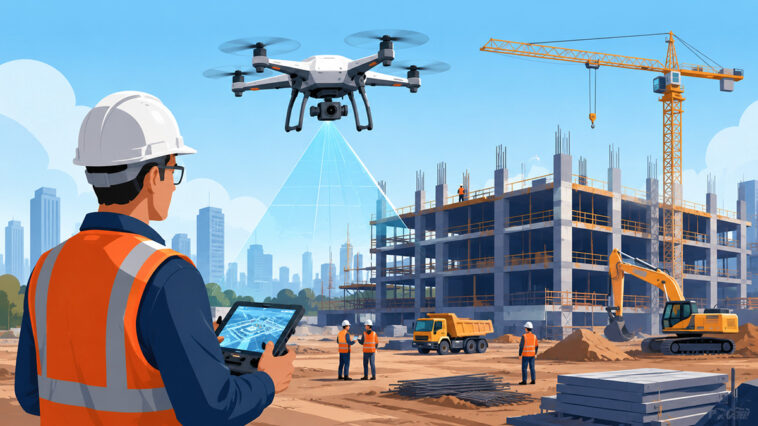
The construction industry has always embraced innovation to improve efficiency, safety, and project outcomes. In recent years, drones—also known as Unmanned Aerial Vehicles (UAVs)—have emerged as one of the most transformative technologies in the sector. From surveying land to monitoring project progress, drones are helping construction companies save time, reduce costs, and make better decisions.
What Are Construction Drones?
Construction drones are remotely operated or autonomous aircraft equipped with cameras, sensors, GPS systems, and imaging technologies. They can capture high-resolution aerial images, videos, and data that provide valuable insights throughout the project lifecycle.
Key Applications of Drones in Construction
1. Site Surveying and Mapping
Traditional land surveying can be time-consuming and labor-intensive. Drones can quickly capture detailed aerial data and generate accurate topographic maps, 3D models, and site measurements within hours instead of days.
Benefits:
- Faster data collection
- Improved accuracy
- Reduced surveying costs
- Access to difficult terrain
2. Progress Monitoring
Project managers can use drones to capture regular aerial photographs and videos of construction sites. This allows stakeholders to track progress, compare completed work against schedules, and identify potential delays.
Benefits:
- Real-time project visibility
- Better communication with clients
- Improved project documentation
- Early identification of issues
3. Safety Inspections
Construction sites often contain hazardous areas that can be dangerous for workers to access. Drones can inspect rooftops, scaffolding, bridges, towers, and other high-risk locations without exposing personnel to unnecessary risks.
Benefits:
- Enhanced worker safety
- Reduced need for manual inspections
- Faster hazard identification
- Compliance with safety standards
4. Volume Measurement and Earthwork Analysis
Drones equipped with photogrammetry software can accurately measure stockpile volumes, excavation quantities, and earthwork progress.
Benefits:
- Accurate quantity calculations
- Better inventory management
- Reduced measurement errors
- Improved project planning
5. Quality Control and Inspection
High-resolution drone imagery allows project teams to inspect construction work in detail and verify that activities meet design specifications.
Benefits:
- Improved quality assurance
- Early detection of defects
- Better record keeping
- Reduced rework costs
6. Marketing and Client Reporting
Drone footage provides impressive visual content that can be used for project presentations, client updates, and marketing campaigns.
Benefits:
- Professional project documentation
- Enhanced client engagement
- Stronger marketing materials
- Improved stakeholder confidence
Major Benefits of Drones in Construction
Increased Efficiency
Drones significantly reduce the time required for surveys, inspections, and progress tracking. Tasks that once took days can often be completed in a few hours.
Cost Savings
By minimizing labor requirements, reducing rework, and improving project management, drones help lower overall project costs.
Better Decision-Making
Accurate aerial data provides project managers with valuable information that supports faster and more informed decisions.
Enhanced Safety
Reducing the need for workers to access dangerous locations helps prevent accidents and creates a safer work environment.
Improved Accuracy
Advanced drone technology delivers highly precise measurements and detailed site information, reducing human error.
Comprehensive Documentation
Regular drone flights create a visual record of project progress, making it easier to resolve disputes, verify work completed, and maintain project records.
Challenges and Considerations
Despite their advantages, construction companies should consider several factors before implementing drone technology:
- Regulatory compliance and licensing requirements
- Pilot training and certification
- Data management and storage
- Weather-related operational limitations
- Initial equipment and software investment
However, as drone technology becomes more affordable and accessible, these challenges are becoming easier to overcome.
The Future of Drones in Construction
The future of drones in construction looks promising. Advances in artificial intelligence, machine learning, and automation are enabling drones to perform increasingly sophisticated tasks. Integration with Building Information Modeling (BIM), digital twins, and real-time analytics will further enhance project management capabilities.
As the construction industry continues its digital transformation, drones are expected to become a standard tool on construction sites worldwide.
Conclusion
Drones are revolutionizing the construction industry by improving efficiency, enhancing safety, reducing costs, and providing valuable project insights. Whether used for surveying, inspections, progress monitoring, or quality control, drones offer significant advantages that help construction companies deliver projects more effectively. Organizations that embrace drone technology today will be better positioned to compete in the increasingly technology-driven construction landscape.